
Inside the facilities: what we built at LEAP Langa and Crossroads, and why it matters
South Africa needs 30,000 new artisans qualifying every year by 2030 to meet the targets set in the National Development Plan. The most recent annual figure is closer to 20,000. Minister Blade Nzimande has stated that 60% of school-leavers should be entering the trades. The current proportion is a fraction of that, and the gap is not closing.
The standard responses to that gap (standalone TVET colleges, after-school training programmes, employer-funded apprenticeships at scale) are necessary but not sufficient. The infrastructure that needs building sits earlier than any of those. It sits inside the mainstream high school timetable.
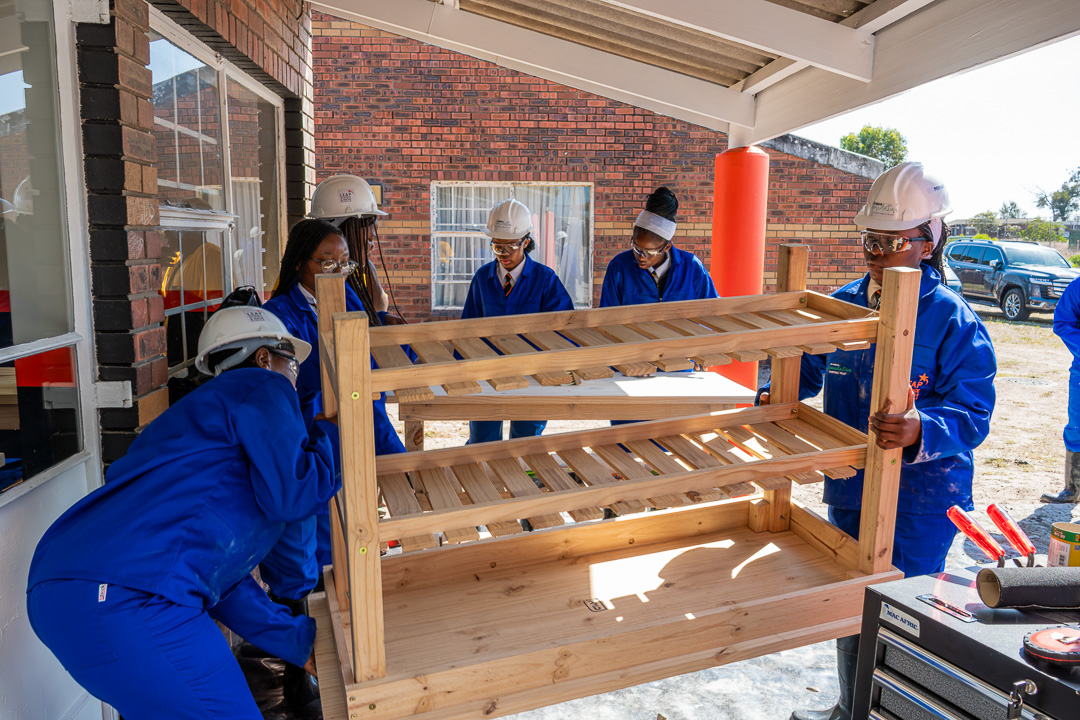
The Hands On Foundation has built and is operating technical faculties inside three mainstream high schools: Wynberg Boys High, LEAP 1 Langa, and LEAP 2 Crossroads. Learners in those schools receive academic education and trade training in the same building, on the same day, taught by qualified artisans alongside their academic teachers. This is infrastructure, not a programme. The buildings are built, occupied, and already in motion.
In April 2026, Cape Town's Deputy Mayor Eddie Andrews visited the two newly launched LEAP campuses. Speaking afterwards about what he had seen inside them, he described it plainly: "Everyone seems happy. There's a sense of purpose. They know exactly what they're trying to achieve." That kind of culture, as we have learnt, is not installed. It is built through consistency, expectation, and belief, on top of a physical space that takes those things seriously.
This piece takes you inside the two newest campuses.
Inside LEAP 1 Langa
Walk through it. Below, we take you inside the LEAP 1 Langa technical faculty.
What's worth noting as you watch: the workshop sits on the same campus as the academic classrooms. There is no transport between buildings, no separate enrolment, and no choice for the learner between an academic and a vocational future. A Grade 10 at Langa has a workshop session on her weekly timetable, taught by a qualified artisan, inside a building she already attends for maths and English.
The equipment installed at the Langa faculty supports training in core trades (woodwork, plumbing, and electrical basics), with the workshop sized and laid out as a working trade environment rather than a demonstration classroom.
Inside LEAP 2 Crossroads
The same approach, applied to a different community. The model is designed to be replicable.
LEAP 2 Crossroads opened more recently and was deliberately built to mirror Langa: same workshop standards, same equipment specification, same integration into the school day. The differences are operational rather than structural, and reflect the community context Crossroads serves.
What stays constant across both campuses is the principle. The workshop is on the same campus as the classrooms. The technical track is part of the learner's ordinary week, not an after-hours decision they have to defend to the people around them.
Why this design works
Three reasons, each evidenced.
First, location removes a barrier. Learners in Langa and Crossroads do not travel out of their community to access technical training. That eliminates transport costs, lost time, and the social cost of being the one in their peer group who chose differently. The barrier we hear about most often in our learner interviews is community-level discouragement of bigger ambitions. An on-campus faculty neutralises it by making the technical track ordinary.
Second, mainstream school infrastructure makes the model sustainable. We are not running a parallel education system. We add a technical faculty to existing, accredited schools, and the school's systems (registration, the academic timetable, parental relationships, the existing teacher base) carry the technical training alongside everything else. The operating cost is significantly lower than a standalone training centre, and the model is significantly easier to replicate.
Third, integration with academic schooling keeps options open. A learner who completes their technical training at LEAP can apply for a trade apprenticeship, a TVET diploma, or a university place. The model doesn't close any doors. The route from a Hands On facility connects to South Africa's strongest available youth employment pathway: the Department of Higher Education and Training's tracer studies show 81% of those who completed artisan apprenticeships were employed afterwards.
What's next
We are working to expand the model. The current bottleneck is not learner interest, school willingness, or evidence of impact. It is infrastructure capital. Each new technical faculty requires equipment investment, workshop fit-out, and operational funding for the first three years before the school's standard cost base absorbs it.
This is where corporate partners and individual donors come in.
How to support this work
For corporate partners with skills development or socio-economic development spend under B-BBEE (where standard targets are 6% of payroll on skills development for 8 points, and 1% of NPAT on socio-economic development for 5 points), our technical faculties are an evidenced-outcome route to deploy that spend. Write to management@thehandsonfoundation.org for a partnership conversation.
For individuals who want to support a learner directly, visit thehandsonfoundation.org/donate.
Sources: Quarterly Labour Force Survey, Statistics South Africa. "Supply and Demand of Artisans in South Africa", Department of Higher Education & Training (National Skills Fund), 2022. National Development Plan 2030. Minister Blade Nzimande address, 10 June 2022. B-BBEE Code Series (Business Optimization Training Institute summary, 2025).
Let’s Build a Future Together
Education is the most powerful tool to break cycles of poverty and inequality. By supporting The Hands On Foundation, you are investing in real skills, real opportunity and real transformation.
